
Solar Farm Erosion Repair: Why Civil Work Is the O&M Problem Most Contractors Can't Handle
When EPC project managers and asset owners think about solar farm O&M, vegetation management and electrical inspections are usually the first line items that come to mind. Civil work — grading, erosion control, stormwater remediation — tends to get treated as a post-construction issue that wraps up when the project reaches COD and doesn't come up again until something goes visibly wrong.
That assumption is costing solar farm operators more than they realize.
Erosion is one of the most common — and most consistently underbudgeted — maintenance challenges on utility-scale solar sites. And unlike a blown fuse or an overgrown fence line, civil damage compounds silently. By the time it's obvious, the remediation work is significantly more complex and more expensive than it would have been with early intervention.
What Solar Farm Erosion Actually Looks Like
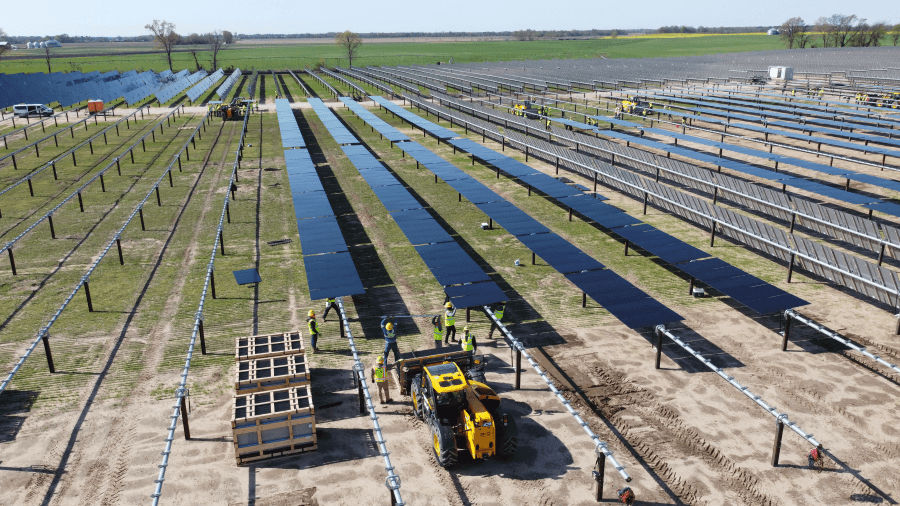
Erosion on a solar farm doesn't always announce itself dramatically. It starts subtly — a small rill forming along a row, a low corner of an access road that collects water after rain, a section of ground cover that's thinning out faster than surrounding areas. These early signs are easy to dismiss as cosmetic.
Left unaddressed, they develop into:
Stormwater channels that cut through the site and undermine racking foundations
Settling and shifting ground beneath pile-driven or ballasted racking systems, causing panel misalignment and structural stress
Exposed aggregate and bare soil that accelerate erosion with every rain event, creating a self-reinforcing cycle
Drainage failures that pond water in areas with electrical infrastructure — a safety and equipment concern
Sediment migration off-site, which can trigger environmental compliance issues and permit violations depending on your site's stormwater permit conditions
In North Carolina and across the Southeast, where clay-heavy soils, high rainfall events, and steep-grade construction pads are common, erosion issues tend to develop faster than operators in drier regions expect. A single significant storm can expose or accelerate problems that had been building for months beneath a thin layer of groundcover.
Why Standard O&M Contractors Can't Handle It
Most solar farm O&M contractors are set up for vegetation management, electrical work, and routine inspections. Civil remediation is a different category of work entirely — it requires different licensing, different equipment, and a different understanding of site hydrology and soil mechanics.
Specifically, meaningful grading and civil remediation on a solar farm requires a licensed grading contractor. In North Carolina, this means a Class A Grading Contractor license — a credential that authorizes work on sites over one acre and that covers the scope of disturbance involved in stormwater channel repair, racking area re-grading, and erosion control installation.
An unlicensed crew doing grading work on a solar farm isn't just a quality concern — it's a liability concern. If that work is later scrutinized during a compliance inspection or an insurance claim, the absence of proper licensing creates problems for the asset owner, not just the contractor.
Revision Solar holds a Class A Grading Contractor license and performs civil remediation work as part of our standard O&M service offering — not as a specialty subcontract that gets handed off to a third party.

What Civil Remediation on a Solar Farm Actually Involves
Erosion channel repair and stormwater rerouting
When water is carving a path across or through your site, the fix isn't filling it back in and hoping for the best. Effective remediation identifies where the water is coming from, where it needs to go, and what surface or structural features are directing it incorrectly. This typically involves re-grading the affected area, installing or repairing drainage channels, armoring high-flow areas with rock or rip-rap, and reestablishing ground cover to stabilize the repaired surface.
Racking area stabilization
Where soil has settled or shifted beneath racking systems, the work involves careful excavation around existing piles or ballast, compacted backfill using appropriate material, and re-grading to restore proper drainage away from the affected area. This work requires both equipment skill and an understanding of the structural constraints of working adjacent to energized solar infrastructure.
Access road and drive lane maintenance
Access roads on solar farms take consistent wear from maintenance vehicles, inspection trucks, and emergency response. Potholes, wash-outs, and edge deterioration make sites harder to service and create equipment damage risk. Routine road grading and base maintenance is significantly cheaper than rebuilding a road section that has been allowed to fail completely.
Post-storm response
Significant weather events — the kind that drop several inches of rain in a short window — can cause rapid and severe erosion on sites that were otherwise stable. Fast response after a major storm limits the secondary damage from a first event and prevents the cascading erosion that develops when initial damage is left to worsen through subsequent rain cycles.
The Cost of Waiting
The pattern we see most often is straightforward: a site has early-stage erosion that's noticed but deprioritized, the damage develops through one or two storm seasons, and by the time it gets formally addressed, the scope of work is three to five times what it would have been with early intervention. The civil budget that was passed on in year two becomes a far larger unplanned expense in year four.
For asset managers operating on long-term O&M agreements, building civil inspection and minor remediation into the annual maintenance cycle — rather than treating it as a reactive line item — is consistently the more cost-effective approach.
Revision Solar provides solar farm civil work and erosion repair as part of our full O&M offering across NC, VA, SC, GA, MD, and the East Coast. If your site has erosion issues that have been on the radar but haven't been addressed, get in touch with our team to discuss a site assessment and remediation scope.

What to Look for on Your Next Site Walk
If you're doing a site inspection and want to assess civil conditions, these are the areas to pay closest attention to:
Low points and corners where water collects after rain — look for bare soil, rilling, or sediment deposits
Access road edges and culvert outlets — common failure points under regular vehicle traffic
Upslope areas where stormwater enters the site — check whether it's being directed appropriately or sheeting across the array
Any area where ground cover is noticeably thinner or absent — bare soil is the precursor to every erosion problem
Around racking piles in lower areas of the site — look for any differential settling or gaps between pile and soil
Early identification keeps civil work in the routine maintenance category. Delayed identification turns it into a capital expense.
Revision Solar's crews provide civil grading and erosion control services for utility-scale solar farms. Learn more about our full range of solar farm O&M services or contact us to discuss your site's needs.


Comments