
How to Build a Solar Farm Vegetation Management Plan That Actually Works
Every utility-scale solar farm needs a vegetation management plan. But having a plan on paper and having a plan that actually protects your site are two very different things.
Too many solar farm vegetation management plans are written once during development, filed away, and never revisited. They contain generic language about "maintaining vegetation at acceptable levels" without defining what that means, how it's measured, or what happens when conditions change. When the plan fails—and generic plans always fail—the result is erosion, invasive species, permit violations, equipment damage, and remediation costs that dwarf what a proper plan would have prevented.
Whether you're developing a new solar farm, taking over operations on an existing site, or evaluating whether your current vegetation management approach is actually working, this guide breaks down what a comprehensive vegetation management plan should include and why each component matters.

Why Generic Vegetation Management Plans Fail
Most vegetation management plans fail for the same reasons:
They're written by people who don't manage vegetation. Development engineers and permitting consultants write plans to satisfy regulatory requirements, not to guide field operations. The resulting documents are technically compliant but operationally useless—full of language about objectives and goals but lacking the specific schedules, methods, and response protocols that crews need to actually manage a site.
They treat every acre the same. A 500-acre solar farm has dozens of distinct vegetation zones—panel rows, access roads, equipment pads, drainage features, property boundaries, pollinator areas, and stormwater management zones. Each requires different management approaches. A plan that prescribes "mow three times per year" across the entire site guarantees that some areas are over-managed and others are neglected.
They don't account for change. Vegetation conditions evolve year over year. Native seed mixes establish, invasive species colonize new areas, drainage patterns shift, and equipment gets added or relocated. A static plan written during construction becomes obsolete within two growing seasons.
They lack accountability metrics. Without specific performance standards—maximum vegetation height around infrastructure, groundcover density requirements, invasive species thresholds—there's no way to evaluate whether the plan is working or whether your contractor is delivering what they promised.
The 8 Components of an Effective Solar Farm Vegetation Management Plan
1. Site-Specific Vegetation Zone Mapping
The foundation of any effective plan is a detailed map dividing the site into distinct management zones, each with its own objectives, methods, and schedules.
Critical zones to define:
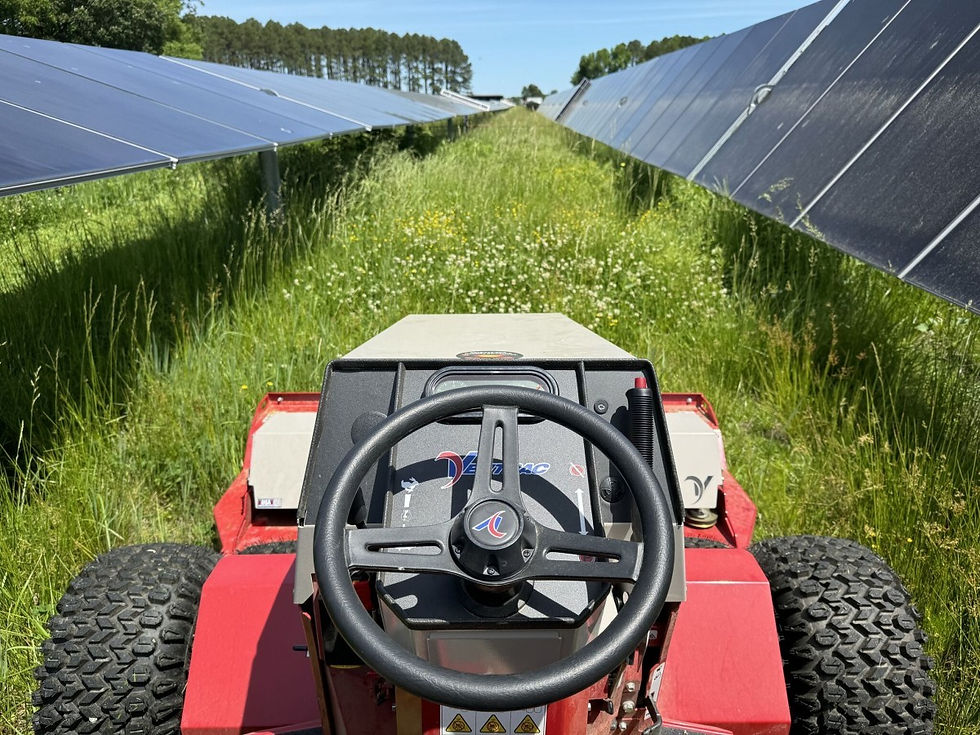
Panel Row Interiors — The space between and under panel rows where vegetation must be kept low enough to avoid shading panels, contacting equipment, or creating fire fuel loads, but tall enough to provide erosion control and suppress invasive species. Typical target: 4–8 inches depending on panel height and racking configuration.
Equipment Areas — Inverter pads, transformer yards, combiner boxes, and switchgear areas requiring vegetation cleared to bare ground or maintained at very low heights for access, safety, and fire prevention. These zones need the most frequent attention—monthly during peak growing season.
Access Roads and Perimeters — Roads, turnarounds, and property boundary areas requiring clear lines of sight, vehicle access, and fire breaks. Vegetation along roads must be low enough for safe vehicle passage and equipment delivery.
Drainage Features — Swales, detention basins, culvert inlets, and discharge points where vegetation serves critical stormwater management functions. These areas often require specialized management—vegetation must be present for erosion control but can't obstruct water flow.
Pollinator and Environmental Areas — Designated zones where native seed mixes, pollinator habitat, or other environmental commitments dictate specific vegetation types and management approaches. These areas are often subject to permit conditions restricting mowing frequency and herbicide use.
Buffer Zones — Areas adjacent to property boundaries, waterways, wetlands, or neighboring properties requiring specialized management to prevent drift, runoff, or visual impacts.
Each zone should have clearly defined boundaries (mapped with GPS coordinates), specific vegetation targets, approved management methods, and a schedule tailored to local growing conditions.
2. Seasonal Management Calendar
An effective plan includes a month-by-month management calendar tailored to the site's climate zone and vegetation types. Generic "three times per year" schedules ignore the reality that vegetation growth is concentrated in specific periods and different management activities are time-sensitive.
Spring (March–May in most regions):
Pre-season site assessment identifying winter damage, erosion, and early invasive species emergence
First mechanical treatment as vegetation reaches action thresholds
Targeted herbicide spot treatment of early-season invasive species before they establish
Equipment pad and infrastructure clearing before peak growing season
Drainage feature inspection and clearing before spring rains
Summer (June–August):
Peak-season mechanical treatments at 4–6 week intervals (climate-dependent)
Post-level detail work around all racking, posts, and foundations
Invasive species monitoring and targeted treatment
Fire fuel load assessment and reduction in high-risk zones
Heat illness prevention protocols for all field crews
Fall (September–November):
Final mechanical treatment before dormancy
Invasive species treatment during fall vulnerability windows
Native seed overseeding where establishment gaps exist
Drainage feature clearing before winter precipitation
Annual site condition assessment and plan review
Winter (December–February):
Dormant season woody vegetation removal
Equipment maintenance and preparation for spring
Plan review and updates based on previous season performance
Contract evaluation and RFP preparation for coming season
The calendar should specify trigger-based management—treating vegetation when it reaches defined height or density thresholds—rather than rigid calendar-based scheduling that ignores actual site conditions.
3. Species-Specific Management Protocols
Different plant species require different control methods. An effective plan identifies the key species present on site and specifies how each should be managed.
Desirable species (native grasses, pollinator plantings, low-growing groundcover): Managed through selective mechanical methods that maintain these species while controlling their height. Herbicide use restricted or prohibited in areas where desirable species are established.
Invasive and noxious species (site-specific, but commonly including Canadian thistle, bindweed, Johnson grass, multiflora rose, phragmites): Specific treatment protocols for each species including timing, method, and follow-up monitoring. Some invasive species require fall herbicide treatment when root systems are actively translocating nutrients. Others respond better to repeated mechanical control during summer.
Woody vegetation (volunteer trees, shrub encroachment): Removal protocols including cut-stump herbicide treatment to prevent regrowth, timing restrictions near nesting seasons, and disposal methods.
Problem grasses (tall fescue, smooth brome, or other aggressive species crowding out native plantings): Management approach balancing control with erosion prevention—you can't simply kill aggressive grasses without having an establishment plan for replacement vegetation.
4. Herbicide Use Protocols
Given the risks of improper herbicide application—covered in detail in our previous post on herbicide damage—an effective vegetation management plan includes strict herbicide protocols:
Approved products list specifying exactly which herbicides are permitted on site, including active ingredients, application rates, and restrictions.
Application method restrictions defining when broadcast spraying is prohibited (usually always) and requiring targeted spot treatment as the default method.
Buffer zone requirements establishing minimum distances from waterways, drainage features, pollinator areas, and property boundaries where herbicide use is restricted or prohibited.
Timing restrictions specifying periods when herbicide use is prohibited—typically during native seed establishment periods, pollinator bloom seasons, and before anticipated heavy rainfall.
Applicator qualifications requiring all herbicide applicators to hold current state licenses and demonstrate familiarity with site-specific restrictions.
Documentation requirements recording every herbicide application including product, rate, location, weather conditions, and applicator identity.
5. Equipment Specifications and Damage Prevention
The plan should specify what equipment is approved for use on site and what restrictions apply:
Approved mowing equipment by zone—flail mowers near panels and infrastructure, rotary mowers in open areas only, handheld equipment for post-level detail work.
Speed restrictions in different zones, especially near panels, cable trays, and equipment pads.
Clearance requirements defining minimum distances between mowing equipment and infrastructure components.
Pre-mowing debris removal requirements in areas prone to rock accumulation.
Prohibited equipment — bush hogs or rotary mowers within defined distances of panels, and any equipment exceeding weight limits for access roads or areas with buried infrastructure.
6. Performance Standards and Accountability Metrics
Without measurable standards, you can't evaluate whether your plan is working. Define specific, measurable targets:
Vegetation height maximums by zone (e.g., 8 inches in panel rows, 4 inches around equipment, 12 inches in buffer zones).
Groundcover density minimums for erosion-sensitive areas (e.g., 70% minimum coverage in stormwater management zones).
Invasive species thresholds triggering mandatory treatment (e.g., treatment required within 14 days when invasive species exceed 10% of any management zone).
Infrastructure clearance standards (e.g., 6–12 inches of bare ground around all posts, equipment pads free of vegetation within 3 feet).
Response time requirements for addressing problems identified during inspections (e.g., erosion repair within 7 days, invasive species treatment within 14 days).
Documentation requirements for every site visit including GPS tracking, photographs, treatment records, and condition reports.
7. Monitoring, Reporting, and Adaptive Management
A plan that doesn't include systematic monitoring is a plan that will fail without anyone noticing until damage is severe.
Monthly site inspections during growing season by the contractor, with written reports including photographs documenting vegetation conditions in each management zone.
Quarterly inspections by site management or an independent third party, comparing conditions against performance standards and identifying areas needing additional attention.
Annual comprehensive assessment reviewing the entire plan against actual site conditions, updating species management protocols, adjusting schedules based on the previous year's performance, and incorporating lessons learned.
Adaptive management protocols specifying how the plan changes when conditions change—new invasive species detected, drainage patterns altered by construction, equipment added or relocated, or climate conditions differing significantly from historical norms.
8. Emergency Response Protocols
Vegetation-related emergencies happen. The plan should address:
Fire response — immediate notification protocols, fuel break maintenance, coordination with local fire departments, and post-fire remediation procedures.
Severe storm response — post-storm site assessment within 48 hours, debris clearing priorities, erosion emergency stabilization, and documentation for insurance claims.
Permit violation response — immediate corrective action procedures, regulatory notification requirements, and remediation timelines.
Equipment damage discovered during vegetation work — reporting protocols, documentation requirements, and coordination with O&M teams for repair scheduling.
Using Your Vegetation Management Plan to Evaluate Contractors
A comprehensive plan isn't just an operational document—it's a contractor accountability tool. When you issue an RFP or evaluate proposals, your plan provides the specific requirements contractors must meet.
Strong proposals will:
Reference your specific management zones and demonstrate understanding of zone-specific requirements
Propose equipment appropriate for each zone (not "we'll bring our standard mowing equipment")
Include labor hour estimates that are realistic for comprehensive coverage
Describe species-specific invasive management approaches
Propose documentation and reporting that meets your plan's requirements
Identify potential challenges specific to your site and propose solutions
Weak proposals will:
Offer generic pricing per acre without zone-specific detail
Propose only tractor-mounted mowing with no handheld equipment for detail work
Provide vague timelines like "monthly service" without trigger-based management
Ignore invasive species management entirely
Offer no documentation beyond invoices
Have no solar-specific safety protocols
Common Plan Gaps That Create Expensive Problems
Even sites with vegetation management plans often have critical gaps:
No first-year establishment protocol. The first 1–2 years after construction are the most critical for vegetation establishment. Sites without specific first-year management—reduced mowing frequency, herbicide restrictions, overseeding schedules—often lose their seed investment and spend years recovering.
No invasive species escalation procedure. When invasive species appear, who decides what action to take? How quickly? At what coverage threshold? Without defined escalation procedures, small infestations become site-wide problems while managers debate response options.
No connection between vegetation and stormwater management. Vegetation management directly affects stormwater compliance. Plans that don't coordinate vegetation activities with stormwater permit requirements create situations where well-intentioned maintenance triggers permit violations.
No plan updates after site modifications. When equipment is added, roads are regraded, or drainage is modified, the vegetation management plan must be updated to reflect new conditions. Static plans become increasingly disconnected from reality over time.
Building or Updating Your Plan: Where to Start
If your site doesn't have a comprehensive vegetation management plan—or has one that exists only on paper—start here:
Step 1: Site Assessment. Walk the entire site with your vegetation management contractor, documenting current conditions in every zone. Identify problem areas, invasive species populations, erosion concerns, and infrastructure access issues.
Step 2: Zone Mapping. Create a detailed zone map with GPS boundaries, assigning each area specific management objectives and methods.
Step 3: Set Performance Standards. Define measurable targets for vegetation height, groundcover density, invasive species coverage, and infrastructure clearance.
Step 4: Build the Calendar. Develop a seasonal management calendar with trigger-based thresholds for each zone, adjusted for your climate and site conditions.
Step 5: Establish Reporting Requirements. Define what documentation contractors must provide for every site visit, including GPS tracks, photographs, treatment records, and condition reports.
Step 6: Review and Update Annually. Schedule a comprehensive plan review every fall, incorporating lessons from the current season and adjusting for the coming year.
Revision Solar's Plan-Based Approach
At Revision Solar, we don't just show up and mow. We work with asset managers and O&M directors to develop and execute comprehensive vegetation management plans tailored to each site's specific conditions, permit requirements, and long-term objectives.
Our approach includes:
Detailed site assessment and zone mapping for every project
Seasonal management calendars with trigger-based treatment thresholds
Species-specific invasive management protocols
Herbicide-conscious treatment strategies prioritizing mechanical methods
Comprehensive documentation including GPS tracking, photography, and condition reporting
Annual plan review and adaptive management updates
We specialize in vegetation control for utility-scale solar farms up to 1,000 acres, providing the systematic, accountable management that protects your infrastructure, maintains compliance, and supports long-term site value.
If your solar farm needs a vegetation management plan that actually works—or your current plan isn't delivering results—contact Revision Solar to discuss a customized approach for your project.


Comments